Friday, 29 June 2012

Sardar Jassa Singh Ahluwalia


Sultan ul Quam Nawab Jassa Singh Ahluwalia (1718-1783) was a prominent Sikh leader during the period of the Sikh Confederacy. He was democratically elected as the supreme military commander of the Sikh Confederacy on March 29,1748 - on Baisakhi, which is considered to be one of the greatest honours given, in the 18th century, to any Sikh.
He was further honoured on 1754 by the Sikh Confederacy with the title of 'Nawab' that was conferred on him at Amritsar, after the passing of Nawab Kapur Singh in 1753.
He was also the Misldar (Chief/Baron) of the Ahluwalia misl or army group. This period was an interlude, lasting roughly from the time of the death of Banda Singh Bahadur in 1716 to the founding of the Sikh Empire in 1801. The period is also sometimes described as the Age of the Misls. He was the also the fourth jathedar (leader) of Buddha Dal.

Early life


Sultan ul Quam Nawab Jassa Singh Ahluwalia was born at the village of Ahlu, in Lahore district of Punjab, (Majha region), in the year 1718. Ahlu village was established by his ancestor, Sadda singh, a disciple of the sixth Sikh GuruGuru Har Gobind. Hence, the name Ahluwalia (meaning from Ahluwal) stuck to him. His forefathers were Kalals (wine merchants). Hence, he is also called Jassa Singh Kalal.

His father, Sardar Badar Singh died in 1723 A.D., when Ahluwalia was hardly five years old. His mother entreated Mata Sundri Kaur, widow of Guru Gobind Singh, to take him into her care. Mata Sundari agreed to do so. She brought him up affectionately, instructing him in the arts of war and peace. He studied Sikh scriptures under Bhai Mani Singh.

Later, Mata Sundar kaur asked Nawab Kapur Singh to take charge of the promising youth, legend has it she told the young boy before his departure that his descendants shall wear maces and be adorned with umbrellas, both signs of nobility: this prophecy would later come to fruition. It will be interesting to note that S, Jassa Singh Ahluwalia was a great Rababinstrumentalist and 'Keertan Kaar', who patronised the Kapurthala Rababi Gharana as well.

Both he and his mother used to perform Hari-Kirtan before Nawab Kapur singh who much pleased at his supreme devotion to the faith and sense of duty and humility. He appointed him as a storekeeper with his forces. Ahluwalia participated in many battles as well where he proved himself to be a natural leader.
Maharaja Jassa Singh Ahluwalia, during his capture of Lahore City In 1761
The formation of the Dal Khalsa and the Misls
1745, the Sikh forces were divided into 65 jathas(bands). Baron Nawab Kapur Singh reorganised them into eleven bands, each of with its own name, flag and leader. These Armies or jathas, which came to known later on as Misls (literally "equal", also "an example") together were, however, given the name of the Dal Khalsa (or the Army of the Khalsa). Baron Jassa Singh Ahluwalia was nominated as the Supreme Commander of the Sikh Confederacy in addition to being Baron of the Ahluwalia Army (misl). Nawab Kapur Singh appointed him as his successor on the eve of his death in 1753. Elated at his successful helmsmanship, the Khalsa honoured Jassa Singh with the title of Sultan-ul-Qaum (King of the nation), when they captured Lahore in 1761. He has been credited for rebuilding the present day holy Harmandir Sahib, in the year 1764, which was destroyed, during the Afghan Invasions.
The raids of Ahmed Shah Abdali


Ahmed Shah Abdali, Nadir Shah's seniormost general, succeeded to the throne of Afghanistan, when Shah was murdered in June, 1747. He established his own dynasty, the Sadozai, which was the name of the Pashtun khel to which he belonged to.

Starting from December, 1747 till 1769, Abdali made a total of nine incursions into India . His repeated invasions destroyed the Mughal administration of the Punjab and the rest of Northern India. At the Third Battle of Panipat, he dealt a drippling blow to Maratha pretensions in the North. Thus he created a power vacuum in the Punjab, which was filled by the Sikhs.


The Sixth Afghan Invasion, 1762: The Great Holocaust


On February 5, 1762, the Sikhs were especially the target of Ahmad Shah Abdali's sixth invasion into India. News had reached him in Afghanistan of the defeat of his general, Nur-ud-Din Bamezai, at the hands of the Sikhs who were fast spreading themselves out over the Punjab and had declared their leader, Baron Jassa Singh Ahluwalia, king of Lahore. To rid his Indian dominion of them once and for all, he set out from Kandahar. Marching with alacrity, he overtook the Sikhs as they were withdrawing into Malwa after crossing the Satluj.

The moving caravan comprised a substantial portion of the total Sikh population and contained, besides active fighters, a large body of old men, women and children who were being escorted to the safety of the interior. Surprised by Ahmad Shah, the Sikhs threw a cordon round those who needed protection, and prepared for the battle. In this formation and continuing their march, they fought the invaders and their Indian allies (The Nawabs of MalerkotlaSirhind, etc.) desperately. Baron Charhat Singh Sukerchakia (the grandfather of Maharaja Ranjit Singh), Baron Hari Singh Dhillon and Baron Jassa Singh Ahluwalia led their forces with skill and courage. Jassa Singh sustained sixty-four wounds on his body, but he survived. Baron Charhat Singh rode to exhaustion, five of his horses one after another.

Ahmad Shah succeeded, in the end, in breaking through the cordon and carried out a full scale massacre. His orders were for everyone in native dress to be killed at sight. The soldiers of Malerkotala and Sirhind were to wear green leaves of trees on their heads to distinguish themselves from the Sikhs. Near the village of Kup, in the vicinity of Malerkotla, about 20,000 Sikhs died at the end of a single day's action (February 5, 1762). This battle is known in Sikh history as the Wadda Ghalughara(The Great Holocaust). During the course of the Battle, Jassa Singh was reported to have had 72 wounds on his body but still survived, as did his counter paths from the other Sikh misls; Charat Singh Sukerchakia for example rode five horses one after the other to exhaustion and Jassa Singh Ramgharia sustained injuries to his body . Upon verbally challenging Ahmed Shah Abdali himself, Jassa Singh is known to have almost killed the Shah, narrowly missing him and killing his horse instead.


The Battle of Amritsar


Despite the Ghalughara disaster, by the month of May, the Sikhs were up in arms again. Under Jassa Singh, they defeated the Afghan faujdar of Sirhind, Zain Khan at Harnaulgarh in revenge for aiding Ahmed Shah Abdali in the holocaust. Instead of killing him, thy accepted his tribute of a large sum of money as they desprately needed the money to repair the Harimandir Sahib, however they promised the faujdar that his time would come (Zain Khan was later killed by Jassa Singh's men in a battle under the ramparts of the Sirhind citadel.) By autumn, the Sikhs had regained enough confidence to foregather in large numbers at Amritsar to celebrate Diwali. Abdali made a mild effort to win over them and sent an envoy with proposals for a treaty of peace. The Sikhs were in no mood for peace and insulted the emissary. Abdali did not waste any time and turned up at the outskirts of Amritsar.

The Second Battle of Amritsar (October 17,1762) was fought in the grey light of a sun in total eclipse. It ended when the sunless day was blacked out by a moonless night with the adversaries retiring from the field: The Sikhs to the fastness of the jungles of the Lakhi (the forests of a hundred thousand trees located in Central Punjab) and Abdali behind the walled safety of Lahore. It was the first major battle against the Sikhs that the Shah was himself present (excluding the Great Holocaust) and ended in total disaster for the Afghan army, Jassa Singh captured a large portion of Ahmed Shah Abdali's troops and forced the very hands that had caused big damage to the holy Sarovar of the Harimandir Sahib to repair and renovate it. After this Jassa Singh, in the greatest gesture of chivalry released the prisoners, warning them not to return to Punjab, many seeing the high character of the Sikh Nation, many Afghans, became Sikhs.


The Eight Afghan Invasion, 1766


In November 1766 Abdali came to the Punjab for the eight time with the avowed object of "crushing the Sikhs". The Sikhs had recourse to their old game of Dhai-phut('hit, run and turn back to hit again') tactics (later made famous at the Battle of Chillianwala against the British). They vacated Lahore, but faced squarely the Afghan general, Jahan Khan atAmritsar. Inflicting a humiliating defeat,and forcing him to retreat, with five thousand Afghan soldiers killed. Jassa Singh Ahluwalia with an army of about twenty thousand Sikhs roamed in the neighbourhood of the Afghan camp, plundering it.


Death


Jassa Singh continued with his campaigns. After Abdali's ninth and last invasion in 1769, Jassa Singh wrested Kapurthala in 1774 from Rao Ibrahim Bhatti and made it his headquarters. Jassa Singh died in Amritsar in 1783 AD. Being without a son (but having two daughters), he was succeeded by Sardar Bhag Singh Ahluwalia, whose son, Fateh Singh became a close collaborator of Ranjit Singh. Like the other Misldars, Jassa Singh also established a Katra or colony for his misl in Amritsar, which was later named Katra Ahluwalia in his honor. He, like many other Misldars also fortified the city of Amritsar for protection against the enimies of Sikhism. His fort and residence is known as Qila Ahluwalia and had unfortunately today fallen in bad shape. He spent his last days greatly renovating the city of Amritsar and reforming Gurdwara managemnet as well has developing the city greatly. Because of his many sacrifices and his great love for the Sikh nation, he was cremated within the Precincts of the Harimandir Sahib, which he fought so hard to protect (considered a great honor in Sikh tradition). A commemorative postage stamp on 'Baba Jassa Singh Ahluwalia' was issued by Government of India on April 04, 1985. Baron Sultan ul Quam Nawab Jassa Singh Kalal was also known as 'Guru ka lal' (the beloved son of Guru). Succeeded by Akali Nihang Baba Naina Singh Ji, as the next Jathedar who had lived upto a very old age.


                                                     Samadh Jassa Singh Ahluwalia 

Aftermath


After the death of Jassa Singh Ahluwalia, in 1783, The Sikh Misls, started fighting each other, from 1783-1799, known as the dark period of Sikh Sovereignty, this weakened the Sikh power, in the Punjab region, soon in 1799, Ranjit Singh, a young Sikh Chieftain, from Gujranwala, captured Lahore, the capital of Punjab, from Sardar Chet Singh Bhangi, bringing an end to the wars between the Sikh States, In the year 1799, and further expanding, his boundaries into Sikh States, and thus bringing back the lost power. Ranjit Singh took the title Maharaja and was crowned in 1801, at the Lahore Fort, within the big massive city walls of Lahore. The Sikhs continue to rule, until 1849, when it was annexed by the British, after the Anglo Sikhs Wars of 1845-49.


                                                      Crumbling Haveli of Maharaja Jassa Singh Ahluwalia, In Kapurthala


Source : http://www.sikhiwiki.org/index.php/Jassa_Singh_Ahluwalia


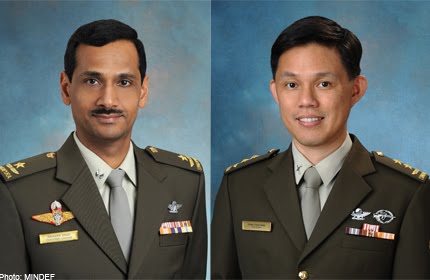
Chief of the Singapore Army Major-General (MG) Ravinder Singh


Ravinder Singh
Birth nameRavinder Singh s/o Harchand Singh
Born1965
AllegianceSingapore
Service/branchSingapore Army
Years of service1982–2009[1]
2011–present
RankMajor-General
Commands heldSignal Battalion
2 Singapore Infantry Brigade
6th Division, Singapore Army
Singapore Army


Major-General (MG) Ravinder Singh s/o Harchand Singh (born 1965) is the Chief of the Singapore Army. He took over the appointment from Chan Chun Sing on 25 March 2011. Before taking up the post, he was deputy secretary of technology at the Ministry of Defence (MINDEF).[2]
Singh served as a regular in the Singapore Army from his enlistment in 1982 until 2009, when he left the service to join MINDEF. He is the highest-ranking officer to have rejoined Singapore's military after reaching the end of his or her military contract.[1] He was promoted to the rank of Major-General on 1 July 2011.
Singh is a SAF Overseas Scholarship recipient and his alma mater include the University of Oxford and the Massachusetts Institute of Technology.[2]
Singh is the first non-Chinese Singaporean Chief of Army since the post was created[3] and the first non-Chinese to hold a significant leadership role since 1982.[1][4]

Ethnic Indian appointed as Singapore Army Chief


Singapore: The appointment of Brigadier-General Ravinder Singh, a Sikh, as the next chief of the Singapore Army is the culmination of a long tradition of the community serving in uniform, both as policemen and in the armed forces, in the city-state.

Their role in Singapore belies their small number: There are only an estimated 12,000 to 15,000 Sikhs in Singapore, a nation of five million people. Their number is small even when compared to 100,000 Sikhs living in Malaysia. Sikhs came to this part of Southeast Asia as soldiers and policemen during the British era.

Brig. Gen. Singh will replace Major-General Chan Chun Sing as army chief March 25.

Singh, 46, currently deputy secretary (technology) in the defence ministry, was previously commanding officer, 3rd Signal Battalion; commander, 2nd Singapore Infantry Brigade and assistant chief of general staff (plans); head joint communications and information systems department.

He has also held the posts of head joint plans and transformation department; commander 6th Division and chief of staff - joint staff. Singh holds a Master of Arts (Engineering Science) from the University of Oxford, Britain. He also holds a Master of Science (Management of Technology) from the Massachusetts Institute of Technology, US.

He joined the Singapore Armed Forces in December 1982. Brig Gen Singh is also the first non-Chinese Chief of Army in nearly 30 years. Colonel Mancharan Singh Gill was the first ever when he took up the post in 1982, the report said.


Source : http://7rangers.blogspot.in/2011/03/ethnic-indian-appointed-as-singapore.html

Thursday, 28 June 2012

Sikh Military Genius puts Pakistan to Shame


It was 1965, after continual refusal to consede to a Punjabi speaking state Sant Fateh Singh sat down to fast and self immolation on the 25th day....but war broke out with Pakistan, who attacked 16 Indian airfields with such lightening strikes....unmatched, that it was apparent Pakistan would decimate the Indians, Pakistanis world over were in glee..... while Delhi was shaken up...

The government was talking to Sikh leaders in Delhi about the Sant ji's fast when the strikes jolted them ... channels were sought to end the fast in this hour of national danger ....

Sant Channan Singh along with a few other Sikh leaders,returned to Amritsar from Delhi, by the night train and conveyed to Sant Fateh Singh on the morning of September 9 the message they had brought. Sant Fateh Singh accepted the advice and made a public statement postponing the fast. Simultaneously, he appealed to his countrymen, especially Sikhs, to muster all their resources to resist the onslaught from across the frontier.Swa Laakh Se Ek laroun was about to be recreated once again ....by the Sikhs to a man!
In the border districts, the hardy and sturdy Sikh population rose to a boy and man, women and girl.. to meet the crisis. They stood solidly behind the combatant Indian army and assisted the army in many different ways to face the relentless drive by the enemy ...
The people of Punjab, provided guides to the newly inducted troops and offered free labour and vehicles, country carts, tractors and trucks to transport war supplies to the forward-most trenches.

Instead of evacuating in panic to safer places,unlike their other country men in rajasthan or gujerat, Sikhs right up to the frontier stuck fearlessly to their homes, plying their ploughs and tending their cattle. Along the main approach routes to the front, they set up booths serving refreshments to the soldiers. 

Their most spectacular feat was the way they swooped down upon the parachutist troops dropped by Pakistanis behind the Indian lines. On seeing the parachutes open up in the skies, the Sikh villagers would rush out gleefully with whatever they had in their hands lathis, axes or swords, and seize the bewildered Pakistani paratroopers before they knew where they were.More than a few were beaten to death on the spot and the rest were handed over to the army, after good going over, if they resisted.

A South Indian pilot belonging to the Air Force, who had made an emergency leap from his crashing aircraft, had a hard time explaining to his rugged, but prompt, captor Sikhs that he was an Indian national, and their country man and not a Pakistani spy.

Besides a vast number of Sikh troops fighting all along the borders from Kutch to Baltistan and Ladakh, almost all senior commanders in the Western and Punjab sector were Sikhs. Lieut-General Harbakhsh Singh, with his chief of staff, Major-General Joginder Singh, commanded the entire Western zone and was, as such, the principal architect of India's victory.He was the man of the day, a proud Sikh standing at over 6 '2.

The disgraced Lt general niranjan parsaad asked to withdraw the army from many fronts in Punjab, in the face of a determined enemy on slaught.But LT GENERAL Harbakhsh Singh going against that, commented if an inch of the land of the Gurus falls to the enemy, the psychological impact on the nation would be so great that ...Delhi will be the only next stop for the advancing Pakistanis!Therefore not a single inch of the land would be allowed to be taken in the Punjab!With such intact Sikh mind, the Sikh generals turned the tide on the enemy within days!

Involved with planning at the army headquarters was another Sikh officer, Major-General Narinder Singh. Lieut-General Joginder Singh Dhillon, a brilliant tactician, with his Brigadier General Staff, Brigadier Parkash Singh Grewal, and artillery commander, Brigadier S.S. Kalha, commanded the troops operating in the Punjab and parts of Rajasthan.There were vast numbers of Sikh troops that showed heroism unmatched ever by any other Indian.
A great battle was fought in Rajasthan under the command of Major Kuldeep Singh Sansarpooriand his handlful Sikhs- merely a company strength held back not only thousands of pakistani troops but a whole armoured battalion of tanks for well over 24 hours until help came ....in the form of the Indian airforce, among whom many Sikh pilots led daring sky fights and raids into pakistan, with their smaller moth fighters against the larger more modern american sabres given to pakistan.A film BORDER symbolises this epic battle.

Major-General Niranjan Prasad was replaced mid-battle by Major-General Mohindar Singh, a tough and shrewd soldier, as division commander in the Amritsar sector, the other division commander, in the Khem Karan sector, being Major-General Gurbakhsh Singh. The two divisions not only secured their first objective, the Ichogil Canal, where more than 4000 men Pakistani brigade fled in the midst of the night ,after about 100 Sikh commando forces landed on the Pakistani side, and bellowed the cries of Bole So Nihal Sat Sri Akal ...it has been recorded that many pakistanis in the darkness of the night cried out the Sat Sri Akal to escape and not be fired upon by their adversaries.... but at other certain points the Sikh commanders outstripped the targets,and soon held Lahore within artillery range.The aspisrations of the Sikh commanders- to capture Lahore were thwarted by Delhi.

Five miles from Lahore at Burki, the victorious Sikh soldiers flew the Nishan sahib over an Old Gurduara, and politely helped aged pakistanis left behind and fed them.

North of the Ravi, Major-General Rajinder Singh 'Sparrow', commanding an armoured division, recorded a marvellous feat in the history of tank warfare by a lightning push towards Sialkot and Narowal miles into Pakistan his Centurion tanks humbling Pakistan's prestigious American gifted Pattons and Chaffees. 

The Khem Karan sector, too, was turned into what came to be known as the GRAVEYARD of the Pakistani Patton tanks, where not only Indian tanks routed the pakistani tanks, but Sikh soldiers armed with dynamites and hand grenades jumped on to pakistani tanks and lobbed them into the tanks. 

South of the Sutlej, Brigadier Bant Singh, commanding an independent Sikh Brigade Group, defended stoutly an extensive border covering the entire Ferozepore and Ganganagar districts. 

To the North in Kashmir many more episodes of heroism of Sikhs troops came to light.One Major Ranjit Singh Dayal,later became Lt General - led his troops up the inpenetrable Haji Pir Pass and captured it , infliciting a devastating blow on the enemy control in the area.
Both at Hussainiwala and Fazilka, Sikh battalion commanders held fast to their positions despite intensely heavy shelling by Pakistan artillery. The Indian Air Force,with many heroic Sikh pilots under the command of the Sikh Air Chief Marshal, Arjan Singh, made devastating strikes and surprised military experts the world over by decisively outpacing a far superior, i.e. better equipped,pakistani Air force. Indian Moth and Gnat fighter planes had routed Pakistani Hawks.

Within 21 days, Pakistan was brought to heel, by this marvelous feat displayed by Sikh Commandersand their troops. The pakistanis literally begged and accepted a ceasefire about on September 22. Legendary stories were already in circulation about the patriotic fervour and bravery Sikhs had displayed during the war.How Sikhs farmers took on trained pakistani paratroops, and how down to a single child the residents of Amritsar and other cities would come up to the roof tops of their houses to cheer their countrymen in air dogfights in the skies. Clearly, their moment of fullfilment had arrived.
The pakistani glee soon was turned into mourning, I recall with fondness the moment when one pakistani man, Mullah Bakshs in my hometown , with tears in his eyes saying to a group of Sikhs gathered....in the Gurduara '...oye ..yaaro nah tusin lende ho ...nah sanu len detaa, sada bhattha betha deta tuhade gernellan ne.....' it was commonly said by pakistanis "...ager na hota Punjab me Sikhon ka killa, hum shaam ko delhi me foot ball khedte .."

If analysed, this war in 1965 was wholly a war fought by Sikh Generals against the pakistanis .....Swa laakh se ek ladaun trully was to be seen .....

On September 6, 1965, the Union Home Minister, Gulzari Lal Nanda, made a statement in the Lok Sabha saying that "the whole question of formation of Punjabi-speaking state could be examined afresh with an open mind." 

That was another part of history long comming to the desh bhagat sikhs yet again.Trials and tribulatuions continued.

But far more sadly neither has the SGPC or any Sikh organisation done anything about such unforgetable Sikh heros, who can be an exemplary role models for the Sikh youth.

Gurcharan Singh Kulim 

http://www.sikhphilosophy.net/history-of-sikhism/32236-sikh-military-genius-puts-pakistan-shame.html

KALPANA'S HISTORY


Kalpana Chawla
 'Kalpana Chawla' ( July 1 , 1961 - February 1 , 2003 ) was an astronaut and space shuttle mission specialist of STS-107
( Columbia ) who was killed when the craft disintegrated after reentry into the Earth's atmosphere .
 Early Life
Chawla was born in Karnal , Haryana , India . Her interest in flight was inspired by J. R. D. Tata , India's first pilot.
 Education
Chawla studied aeronautical engineering at the Punjab Engineering College in 1982 where she earned her Bachelor of Science degree. Thereafter she moved to the United States to obtain a Master of Science degree in aerospace engineering from University of Texas ( 1984 ). Dr. Chawla earned a doctorate in aerospace engineering from University of Colorado in 1988 . That same year she began working for NASA 's Ames Research Center . Kalpana Chawla became a naturalized USA citizen, and married Jean-Pierre Harrison, a freelance flying instructor. Chawla held a certified flight instructor's license with airplane and glider ratings, and has commercial pilot's licenses for single and multiengine land and seaplanes.
NASA Career
Dr. Chawla entered NASA's astronaut program in 1994 and was selected for flight in 1996 . Chawla's first mission to space began on November 19 , 1997 as part of the 6 astronaut crew that flew the Space Shuttle Columbia Flight STS-87 . Chawla was the first Indian-born woman in space, as well as the first Indian-American in space. (She was the second person from India to fly into space, after cosmonaut Rakesh Sharma who went into space in 1984 in a Soviet spacecraft.)
On her first mission Chawla travelled over 6.5 million miles in 252 orbits of the earth, logging more than 375 hours in space. During STS-87, she was responsible for deploying the Spartan Satellite which malfunctioned forcing two other astronauts to go on a spacewalk to capture the solar satellite. A five-month NASA investigation blamed the error on the flight crew and ground control. She was fully exonerated (although this did not stop some reporters from making direspectful comments about her involvement in the mishap in the days after her death in the explosion of the final Columbia mission). After being selected for a second flight, Chawla lived at the Lyndon B Johnson Space Center in Houston, Texas , undergoing extensive training. Chawla's mission got delayed in July 2002 when NASA engineers identified three cracks on the shuttle's second engine's liquid hydrogen flow liner. Over six months later the shuttle was cleared and she returned to space in the ill-fated STS-107 mission.
Chawla was dedicated to the scientific goals of SPACEHAB/FREESTAR microgravity research mission, for which the crew conducted nearly 80 experiments studying earth and space science, advance technology development, and astronaut health and safety.
Personal Characteristics
Chawla was a strict vegetarian . On her mission, she carried a white silk banner as part of a worldwide campaign to honor teachers, as well as nearly two dozen CDs, including ones by Abida Parveen , Yehudi Menuhin , Ravi Shankar , and Deep Purple . She went to her first rock concert, a Deep Purple show, in 2001 with her husband. "Kalpana is not necessarily a rock music aficionado," her husband said of a Deep Purple show they went to in 2001. "But (she) nevertheless characterized the show as a 'spiritual experience.'" The administrator for the Hindu temple in Houston where Chawla attended when her schedule permitted said "She was a nice lady ... and very pious."
Memoria
Shortly after her last mission, India renamed its first weather satellite 'Kalpana-1' in her honor. She died a hero and a role-model for many young women, particularly those in her hometown of Karnal where she periodically returned to encourage young girls to follow in her footsteps. Her brother, Sanjay Chawla , remarked "To me, my sister is not dead. She is immortal. Isn't that what a star is? She is a permanent star in the sky. She will always be up there where she belongs."

Astronaut Kalpana Chawla


              Biography of Kalpana Chawla


“I could then see my reflection in the window and in the retina of my eyes the whole earth and the sky could be seen reflected ... So I called all the crew members one by one and they all saw it and evelybody said, “Oh .. Wow”, Columbia Astronaut Kalpana Chawla on seeing her reflection in the Orbiters overhead window.
Born in Karnal, India. Kalpana Chawla enjoys flying, hiking, back-packing, and reading. She holds Certificated Flight Instructor’s license with airplane and glider ratings, Commercial Pilot’s licenses for single- and multi-engine land and seaplanes, Gliders and instrument rating for airplanes.
Graduated from Tagore School, Karnal, India, in 1976. Bachelor of Science degree in Aeronautical Engineering from Punjab Engineering College, India, 1982. Master of Science degree in aerospace engineering from University of Texas, 1984. Doctorate of Philosophy in aerospace engineering from University of Colora do, 1988.
In 1988, Kalpana Chawla started work at NASA Ames Research Centre in the area of powered-lift computational fluid dynamics. Her research concentrated on Simulation of complex air flows encountered around aircraft such as the Harrier in “ground-effect.” Following completion of this project she supported research in mapping of flow solvers to parallel computers and testing of these solvers by carrying out powered lift computations. In 1993 Kalpana Chawlajoined overset Methods Inc., Los Altos, California, as Vice President and Research Scientist to form a team with other researchers specializing in simulation of moving multiple body problems. She was responsible for development and implementation of efficient techniques to perform aerodynamic optimization. Results of various projects that Kalpana Chawla participated in are documented in technical conference papers and journals.
Selected by NASA in December 1994, Kalpana Chawla reported to the Johnson Space Centre in March 1995 as an astronaut candidate in the 15th Group of Astronauts. After completing a year of training and evaluation she was assigned as representative to work technical issues for the Astronaut Office EV Af Robotics md Computer Branches. Her assignments included work on development of Robotic Awareness Displays and testing space shuttle control software in the Shuttle Avionics.
In November, 1996, Kalpana Chawla was assigned as mission specialist and prime robotic am1 operator on STS-87 (November 19 to December 5, 1997). STS­-87 was the fourth U.S Microgravity Payload flight and focused on experiments designed to study how the weightless environment of space affects various physic processes, and on observations of the Sun’s outer atmospheric layers. Two members of the crew performed an EVA (spacewalk) which featured the manual capture of a Spartan satellite, in addition to testing EVA tools and procedures for future Space Station assembly. In completing her first mission, Kalpana Chawla travelled 6.5 million miles in 252 orbits of the Earth and logged 376 hours and 34 minutes in space. In January, 1998, Kalpana Chawla was assigned as crew representative for shuttle and station flight crew equipment. Subsequently, she was assigned as the lead for Astronaut Office’s Crew Systems and Habitability section. She was assigned to the crew of STS-107 scheduled for launch in 2003.
STS-I07 Columbia (January 16 to February 1,2003). The 16-day flight was a dedicated science and research mission. Working 24 hours a day, in two alternative shifts, the crew successfully conducted approximately 80 experiments. The STS107 mission ended abruptly on February 1,2003 when Space Shuttle Columbia and her crew perished during entry, 16 minutes prior to scheduled landing.
Karnal residents and hundreds of millions of Indians had been elated at Chawla. The 40-year-old became the first Indian woman to enter space in 1997, when she was part of the Columbia mission that orbited the earth. (Profile of Chawla)
Though deeply saddened, Chawla’s brother, Sanjay, tried to be philosophical about her death, “When you’re involved in such a profession, you need to be ready for this kind of news,” he told CNN’  Satinder Bindra. “I was just telling my friends that if you ‘re in the army or air force or any such field, you should be ready to receive such news.”
“When this can happen to others, it can also’ happen to you. This time, such a tragedy has befallen our family, but our relatives and friends and the people of KarnaI are all sharing our grief,” the brother added.
In India, which has launched satellites for years and is preparing for a moon orbit this decade, Chawla was a new kind of heroine.
Prior to her departure for what was her second trip to space, she told reporters that her inspiration to take up flying was J.R.D. Tata who flew the first mail flights in India.
She told the Press Trust of India on January 16: “What J.R.D. Tata had done during those years was very intriguing and definitely captivated my imagination”
Following her first space flight, in 1997, she had told News India-Times of seeing India’s Himalayan Mountains.
“The Gauges Valley looked majestic, mind boggling,” she said.
Chawla said that as the shuttle repeatedly passed over India, especially New Delhi, she had pointed it out to the other crew members and said, “I lived nearest there”
Front pages of Saturday’s Indian newspapers carried pictures of Kalpana Chawla, the first Indian-born woman in space, to celebrate her expected return to earth on the U.S. space shuttle Columbia. But the return never happened as the shuttle broke apart more than 2,00,000 feet above central Texas minutes before it was to land in Bonda, killing all seven crew members. (Full story)
Instead of a celebration, a pall of sadness descended on India as much of the country watched with horror the video footage showing the disintegration of the space shuttle Columbia.
In a letter to V.S. President George W. Bush, Indian Prime Minister Atal Behari Vajpayee conveyed his sympathies to the American people, “We mourn with you in this moment of grief. Our hearts go out to the bright young men and women who were on that spacecraft. For us in India, we felt that since one of them was an Indian-born to man it adds a special poignancy to the tragedy.”
“The world has seen with admiration the V.S. spacecraft program. We hope that in the days to come it will reach new heights,” Vajpayee added. Long live the memories of Kalpana an inspiring legend.

Breaking the Mold: Namrata Singh Gujral


Namrata Singh Gujral
Beautiful, smart, talented, and successful - and in Hollywood, of all places. Too good to be true, right?

Wrong.  These words describe Namrata Singh Gujral, an actress based in Hollywood who not only has her Screen Actors Guild card but also runs her own production company called American Pride Films.  The company's newest feature - Americanizing Shelley - is a film Namrata co-wrote partly because she saw that there were no movies that were commercial but still addressed the issues that Sikh-Americans face today.

When asked whether she has experienced any typecasting in her career, she confessed that when she first started in the industry, she was asked to go on twelve auditions, each one for a role of a wife following her husband around.  She was actually required to cry at her auditions because that was an important aspect of the melodramatic roles.

Needless to say, it became boring  pretty quickly: it was clear that there was no dearth for roles for the stereotypical Indian wife.

It's not that Namrata didn't want emotional roles.  She just wished that roles for South Asian women were of the same caliber as the roles offered to other actresses.  Namrata found the solution in casting a wider net for good roles.  Consequently, she has played Latin-American and even Persian women.

Namrata has achieved great success considering the short time that she has been in the industry.  Not only has she acted in "House of Sand and Fog" starring Oscar winner Ben Kingsley, but she has also had a recurring role as a nurse on the popular soap opera "Passions".  She has also been in a Bollywood film called Kaante.

"In Bollywood," Namrata says, "it's a lot easier to get roles."

Bollywood makes many movies but making it in Hollywood is much more difficult and more of an accomplishment.  "The reason," she continues, "could be because most Bollywood actors lack formal training and have trouble connecting with the audience."  Though she was offered roles in Bollywood,  Namrata decided that she would rather work in Hollywood.

She was showcased recently as part of the "Sikhs in Hollywood" panel at the Gala preceding the recent Spinning Wheel Film Festival held in Anaheim, California. It was at the festival, Namrata points out, that she had a chance to meet likeminded individuals - people who knew that you didn't have to preach to an audience in order to teach them something.  Namrata says she was blown away by the quality of the films she saw that day.

"Whether they were long or short, they were polished and it was clear that a great deal of thought and effort had gone into them", she adds.

Namrata is qualified to make that judgment because she studied film at university and graduated with a 4.0 - the highest mark one can get. She knows what makes a film good or bad and applies these judgments to any roles that come her way.  Besides her academic accomplishments, she has become somewhat of an icon in the Sikh-American and Indian communities.  She has been invited to speak on panels on being a Sikh and Indian working in Hollywood.

In 2005 Namrata was also a member of the US Republican Party's panel on the Entertainment industry at an annual convention, where she shared the podium with Vice-President Dick Cheney. And, oddly  -  but understandably  -   was declared the GOP "Babe of the Week" at the convention!  [For "Beauty and Brains", explain the Republican web-sites.] She spoke about the need to support ventures such as her production company which aims to be inclusive and, at the same time, make pro-America films.  It was Namrata's chance to show the Party that not only did people in Hollywood care about America, but so did Sikhs and other visible minorities.

Also, being a member of panels where she speaks directly to South Asians and Sikhs is "a great honour", says Namrata, and quickly adds that she welcomes every opportunity to counsel others who hope to get into the industry.  She admits, however, that besides talent one needs luck as well to get your foot in the door.

Namrata has a passion for making films for the new generation.  She knows that the last thing most people want when they go to see a film is to be blatantly educated by it.  Namrata realizes that, primarily, audiences want to be entertained - if they learn something along the way, then that's a bonus.

It's this principle that she applied when making Americanizing Shelley.  The movie is a romantic comedy, but Namrata hints that audiences will, along the way, also learn a little bit about Sikhs. The film, however, does not market itself just towards the new-American  communities  -  Namrata is confident that the film is one that the general population at large will want to see.

Tarsem Singh


"Tarsem Dhandwar Singh" (born 26 May 1961), known professionally simply as "Tarsem", is an Indian film director who has worked on films, music videos, and commercials.


Tarsem was born in Jalandhar, Punjab.His father was an aircraft engineer. He grew up in the Himalayas, where his father sent him from Iran after foreseeing that the Mullahs would come into power and concluding that Iran would not be the best place to raise his child. He is a graduate of Art Center College of Design, located in Pasadena, California. He attended the Bishop Cotton School, Simla, India where he was the Captain of Ibbetson House in 1978 and was awarded the 'Full School Blazer' for his outstanding performance in academics.
Tarsem began his career directing music videos, including those of 'Hold On' by En Vogue, 'Sweet Lullaby' by Deep Forest and R.E.M.'s smash hit 'Losing My Religion,' the latter of which won Best Video of the Year at the 1991 MTV Video Music Awards. He has directed dozens of commercials for brands such as Nike and Coca-Cola. Tarsem's feature film directorial debut was "The Cell" (2000), starring Jennifer Lopez. His second film, "The Fall", debuted at the 2006 Toronto International Film Festival and was released theatrically in the United States in 2008. His third film will be called "Immortals".
Pepsi Commercial: 'We Will Rock You'
This commercial, directed by Singh, is one of the more elaborate Pepsi commercials to date. It combines a gladiator theme with the hard rock Queen's 'We Will Rock You'. The stars involved in this commercial include Enrique Iglesias who plays the role of an emperor hoarding Pepsi, Britney Spears, Alecia Beth Moore (Pink) and Beyonce Knowles, all playing similar roles of gladiators about to engage in combat for the emperor's and crowd's enjoyment. Ultimately the gladiators turn against the emperor and throw him from his seat. Tarsem was commended within the 'Making of the Pepsi Commercial' video several occasions by Beyonce Knowles, Enrique Iglesias and Pink.

GURINDER CHADHA


ABOUT GURINDER CHADHA
It was no surprise that director Gurinder Chadha, despite a traditional upbringing in a Punjabi household, did more than what was expected of an Indian woman. Her distinctly Anglo surroundings in Southall, London did more than just fuel her curiosity about other cultures; she sometimes outright rejected her family's heritage - like learning classical Indian dances or learning how to cook Aloo Gobi - in order to find her own identity. But as she grew older and more aware of the burgeoning Anglo-Asian subculture right under her nose, she developed an active interest in her mixed cultural identity, wearing traditional Indian dress and headwear with Doc Martins, for example, while becoming disenchanted with how her people were perceived. Her displeasure fueled her desire to see better, accurate portrayals of Indians in popular culture as she strove to become a film director.
Chadha was born in Kenya, but moved to Southall when she was just a baby. Her father - an accountant by trade - faced discrimination in the then-exclusively white neighborhood and had trouble finding work in his field. Instead, he worked at a local bakery and rubber factory - a struggle he endured to keep his family afloat. He switched jobs and became a postman, then worked on the gas board, eventually saving up enough money to start a general store. Chadha attended the Beaconsfield Primary School in Southall, before taking development studies where she learned the politics and economics of developing nations at East Anglia University, 120 miles away from her hometown. Upon graduating, Chadha worked at the BBC as a radio journalist, but disliked the self-importance of the other journalists. After being exposed to the bhangra dance scene, her life suddenly changed - she felt a connection to her mixed British-Asian culture for the first time and set out to explore it through film.
Among Chadha's early work, with which she began her fruitful alliance with British Film Institute and Channel 4 as producers, was the 30-minute documentary, "I'm English But..." (1989), which followed young English-Asians who defied their parent's traditions by listening to Acid Bhangra, a mix of Punjabi bhangra and rap. Her first dramatic film short was the 11-minute "Nice Arrangement" (1990), about a mixed-culture wedding. Chadha went on to helm her first feature, "Bhaji on the Beach" (1993), an Asian feminist comedy with a cheeky wit and a more serious political thematic underpinning, tracing the adventures of a busload of Anglo-Asian women on holiday in the vacation spot of Blackpool. The characters momentarily leave behind lives - though full of humor and camaraderie - that are marked by sexism, racism and personal traumas. The film was nominated for the Best British Film BAFTA award, while Chadha won the Evening Standard award for Best Newcomer to British Cinema.
Unable to capitalize on the critical success of "Bhaji on the Beach," Chadha spent a better part of the 1990s working on a script for a Bollywood film with brothers Sunny and Bobby Deol that never came to fruition. After turning out the 1994 short "What Do You Call an Indian Woman Who's Funny?" and making a cameo appearance as a reporter in friend John Landis' "The Stupids" (1996), Chadha returned to features with "What's Cooking?" (2000), selected as the opening night film at the Sundance Film Festival. Following four ethnically diverse families - Jewish, African-American, Latino and Vietnamese - the film took a lighthearted look at the differences in race, culture, politics and even sexuality while the characters prepare to feast on Thanksgiving dinner. Prior to making "What's Cooking?" Chadha became inspired by her fellow Brits' dismay over losing in the 1998 World Cup, causing her to think what it would be like to put an Indian girl in the center of the football world.
The result of her inspiration became her signature film, "Bend It Like Beckham" (2002), a coming-of-age dramatic comedy about Jess Bhamra (Parminder Nagra), an independent and spirited 19-year-old Indian girl living with her traditionally-minded parents in London while dreaming about playing European football. While secretly playing at a park - her parents would never allow such unorthodox behavior - she meets Jules (Keira Knightley), a semi-pro player who's immediately impressed by her skills and asks Jess to play. As her passion in following hero David Beckham's footsteps clashes with her family's traditionalist views, Jess is forced to lead a double life as a student and footballer. "Beckham" became a hit in England and across Europe in 2002, eventually making the trip across the Atlantic to take in over $32 million at the American box office. The film earned a Golden Globe nomination for Best Motion Picture - Musical or Comedy, while Chadha shared a nomination for Best Original Screenplay by the Writer's Guild of America with husband, Paul Mayeda Berges.
For her next film, Chadha adapted Jane Austen's most famous and much-adapted novel "Pride and Prejudice," giving it the Bollywood treatment by turning the early-19th century story about courtship and marriage into a modern day cultural clash musical. In Chadha's updated version, an Indian mother (Nadira Babbar) seeks to marry off her four beautiful daughters, but runs into trouble when the smart and head-strong Lalita (Aishwarya Rai) only wants to marry for love. Then Lalita meets arrogant Californian Will Darcy (Martin Henderson), the son of a wealthy hotel magnate, and the sparks of love - or is it hate? - start to fly. Both are smitten and suspicious of one another, as Lalita and Darcy try to overcome their prejudices so that love can flourish. Not nearly the financial success as its predecessor, "Bride and Prejudice" nonetheless pleased critics.
After scripting her husband's directorial debut, "The Mistress of Spices" (2005), a supernatural romance about an Indian woman (Rai again) who fears she'll lose her mystical healing powers when she falls in love with an American man (Dylan McDermott), Chandha was picked by Fox to helm her first major Hollywood movie, "Dallas" (2007). The star-laden film - including John Travolta and Jennifer Lopez - was an update on the popular 1980s television series where J.R. Ewing is the head of the most powerful energy company in the world.

CAREER MILESTONES

Directed several TV documentaries for BBC, Channel 4 and the British Film Institute, including Acting Our Age (1991) and Pain, Passion & Profit (1992)

Will direct John Travolta and Jennifer Lopez in a big-screen version of the 1980s TV show Dallas

Worked as a radio news reporter for the BBC

1961 Left Kenya with family; moved to Southall, London (date approximate)
1989 Short film directorial debut, I m British But...
1993 Feature directorial debut, Bhaji at the Beach
1994 Directed the short What Do You Call an Indian Woman Who s Funny?
1995 Helmed the British TV-movie Rich Deceiver (BBC)
1996 Had small role as a reporter in John Landis The Stupids
2000 Second feature, What s Cooking? , premiered at Sundance Film Festival
2002 Helmed the sports-themed Bend It Like Beckham ; received a Golden
        Globe nomination for Best Comedy or Musical Picture
2005 Directed Bride and Prejudice a Bollywood update of the Jane Austen s
        classic tale.